Market Structure Framework
AUCTION MARKET THEORY
Learn how markets establish value, transition between balance and imbalance, and reveal trader intent through price, time, and volume.
Value
Defines where the market is accepting price so traders can understand rotation, rejection, and value discovery.
Behavior
Shows whether traders are defending established value or aggressively pushing into new price territory.
Execution
Turns market context into a plan by separating mean reversion conditions from expansion conditions.
01FoundationUnderstanding Market Structure Through Auction Theory
Markets move through buyers and sellers continuously negotiating value in real time.
01
Foundation
Understanding Market Structure Through Auction Theory
Markets move through buyers and sellers continuously negotiating value in real time.
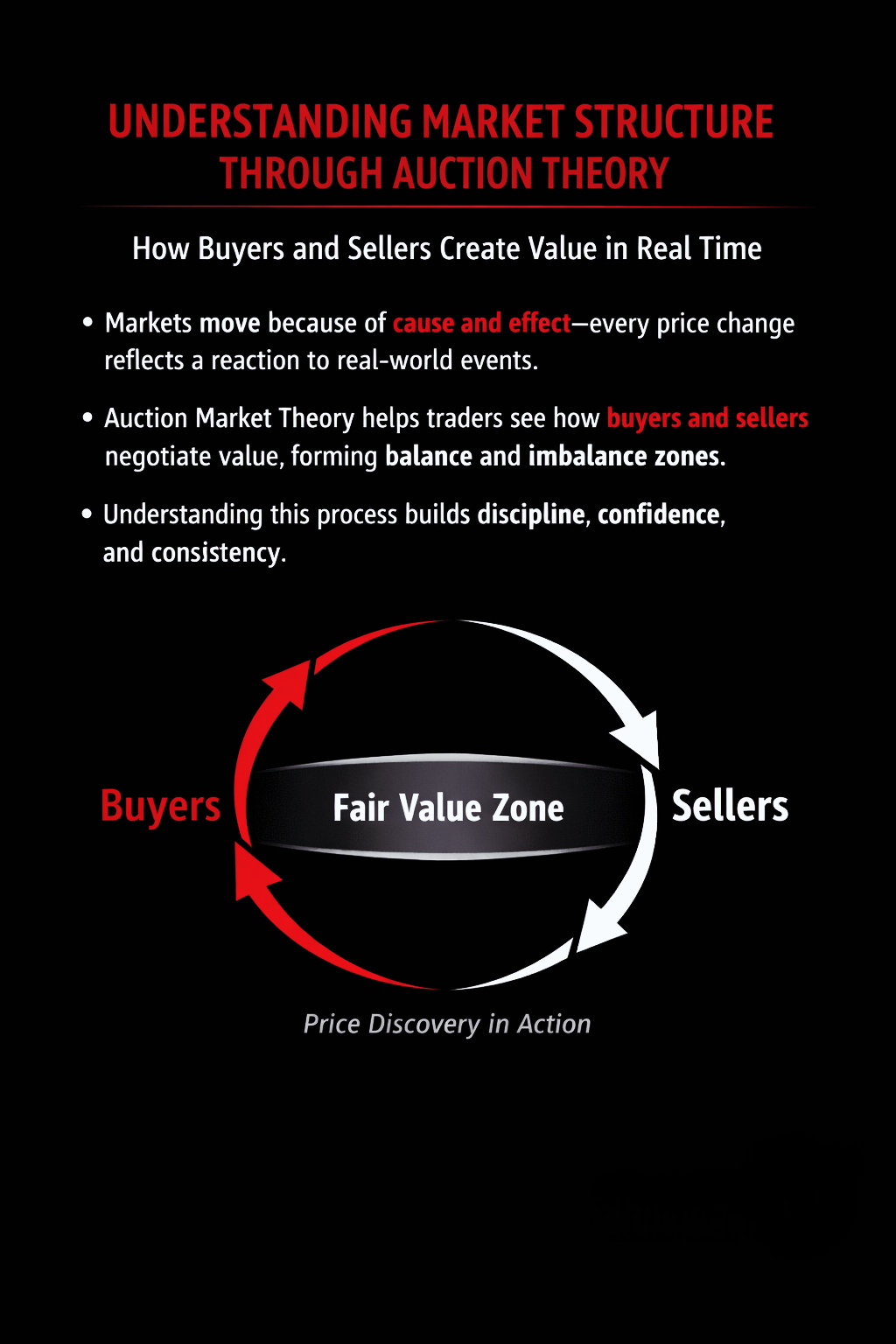
Auction Market Theory helps explain how buyers and sellers negotiate value in real time. Instead of seeing every candle as random movement, AMT frames price as a constant auction where participants accept, reject, defend, or chase value.
Markets move through cause and effect.
Buyers and sellers negotiate fair value.
Balance and imbalance define market behavior.
02Core PillarsPrice • Time • Volume
Price advertises opportunity, time regulates availability, and volume confirms participation.
02
Core Pillars
Price • Time • Volume
Price advertises opportunity, time regulates availability, and volume confirms participation.
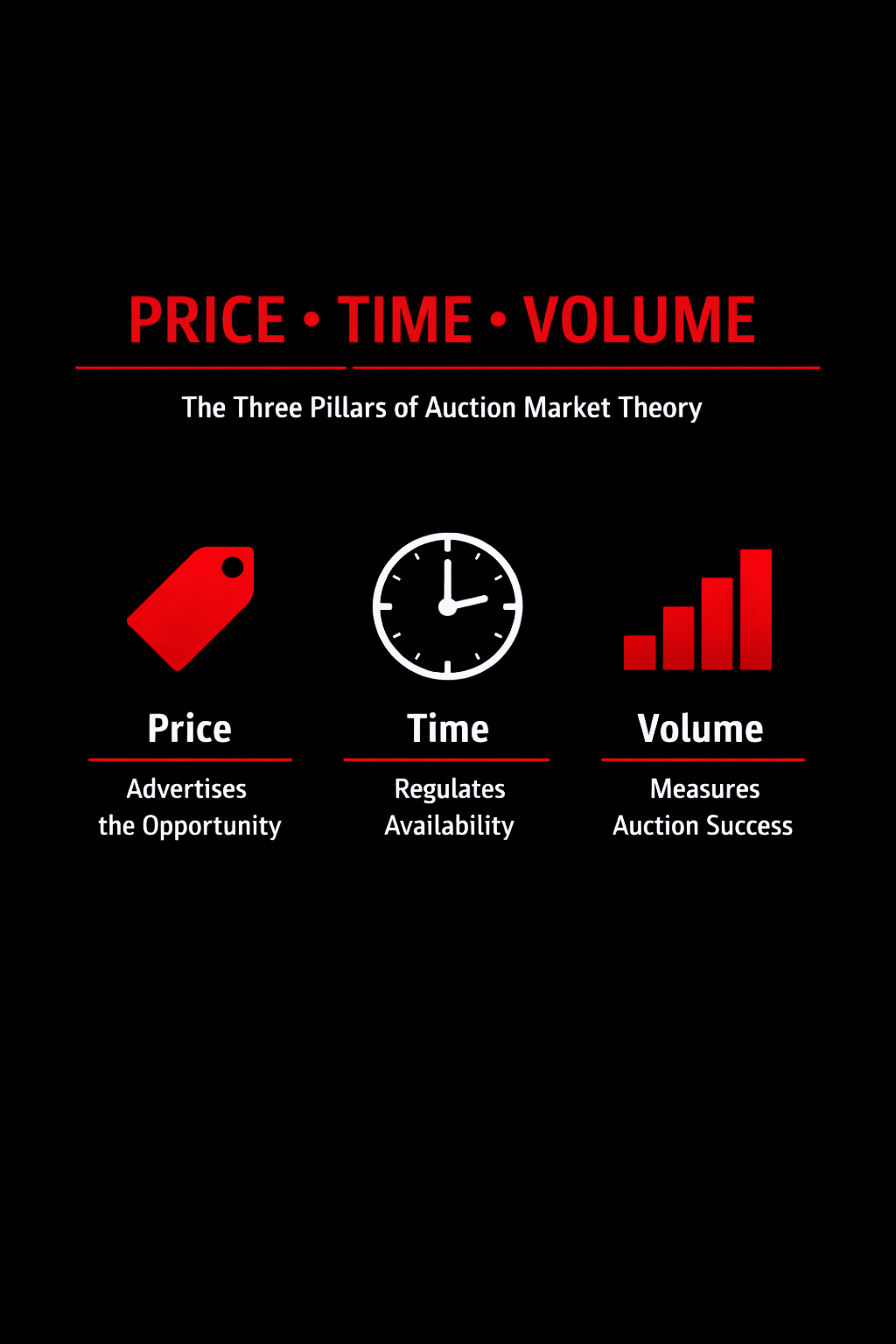
These are the three pillars of the auction. Price advertises opportunity, time shows how long the market accepts that opportunity, and volume confirms whether participation supports the move.
Price advertises opportunity.
Time regulates availability.
Volume measures auction success.
03ValueFair Value Zone
Fair value is where the market has found the strongest agreement between buyers and sellers.
03
Value
Fair Value Zone
Fair value is where the market has found the strongest agreement between buyers and sellers.
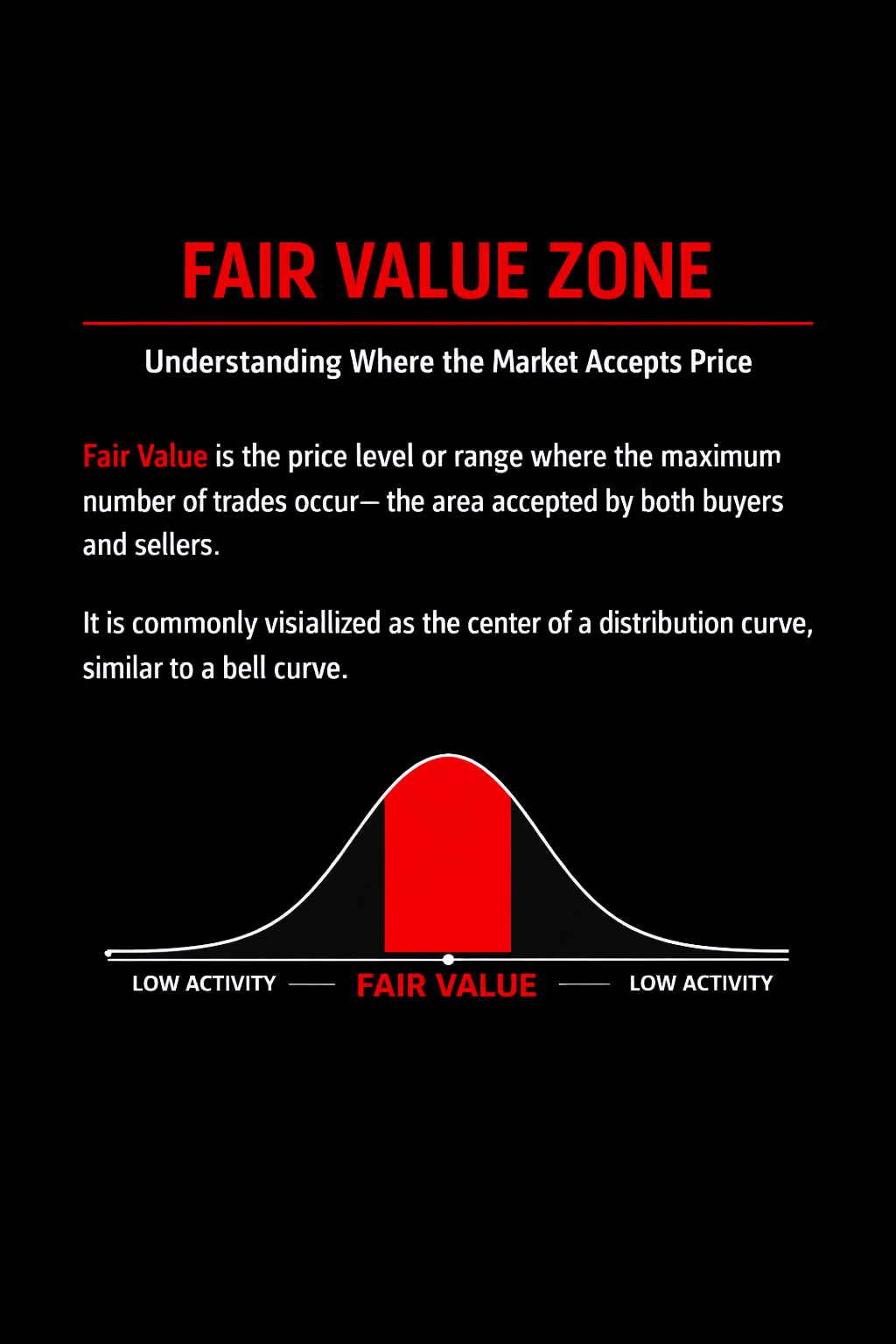
Fair value is the area where the market has found agreement. When price spends time in an area and volume builds there, it signals acceptance. This becomes the reference zone traders use to judge whether price is cheap, expensive, or fairly valued.
Accepted price area.
Often forms near the center of distribution.
Useful as a reference for future rotations.
04ContextValue Area Concepts
VAH, POC, and VAL help map where price is being accepted or rejected.
04
Context
Value Area Concepts
VAH, POC, and VAL help map where price is being accepted or rejected.
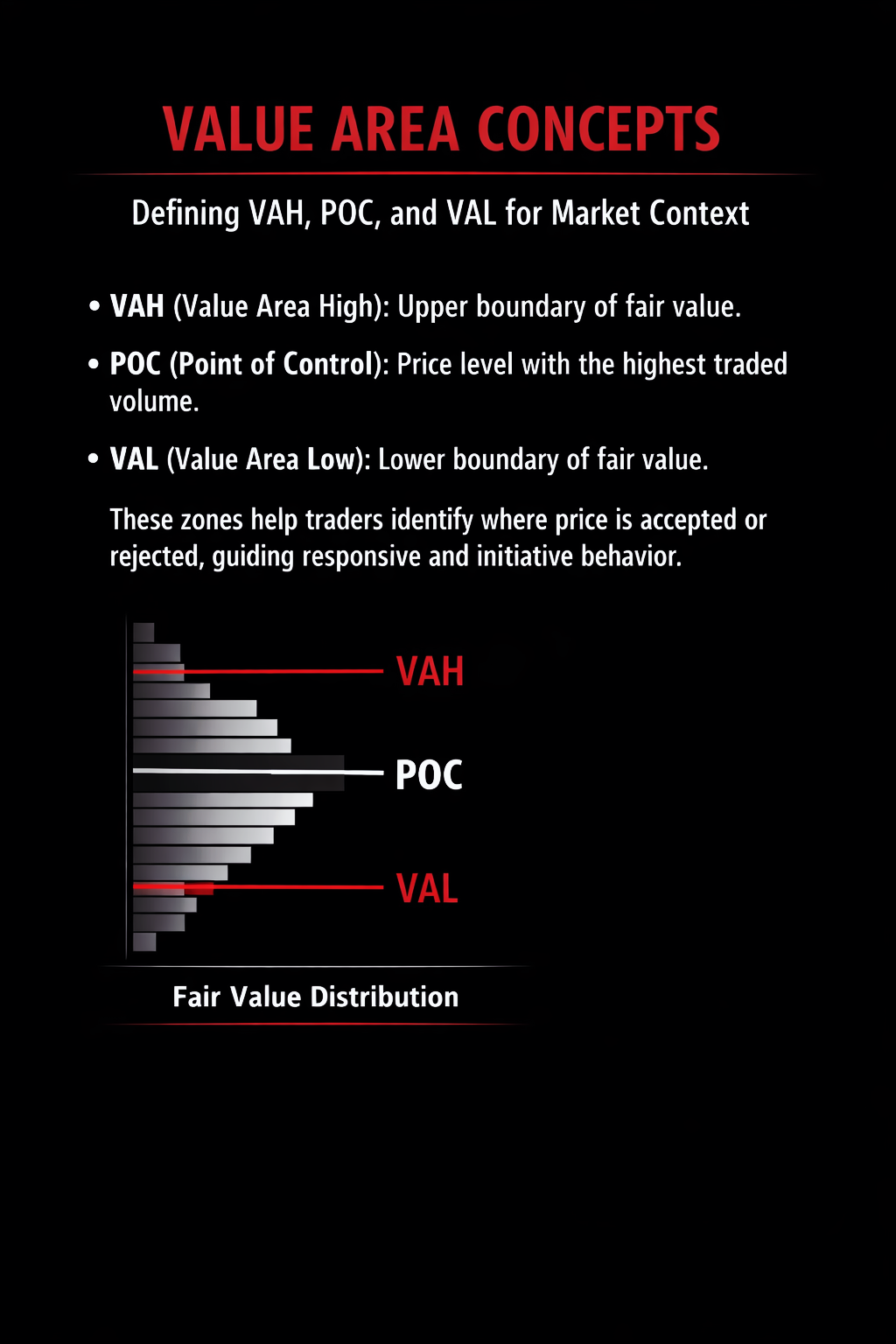
VAH, POC, and VAL help map where the market has accepted value. These levels give structure to the auction and help traders identify whether price is rotating inside value or attempting to break away from it.
VAH marks the upper accepted value boundary.
POC marks the highest participation area.
VAL marks the lower accepted value boundary.
05Market CycleBalance vs Imbalance
Balanced markets rotate around value, while imbalanced markets expand to discover new value.
05
Market Cycle
Balance vs Imbalance
Balanced markets rotate around value, while imbalanced markets expand to discover new value.
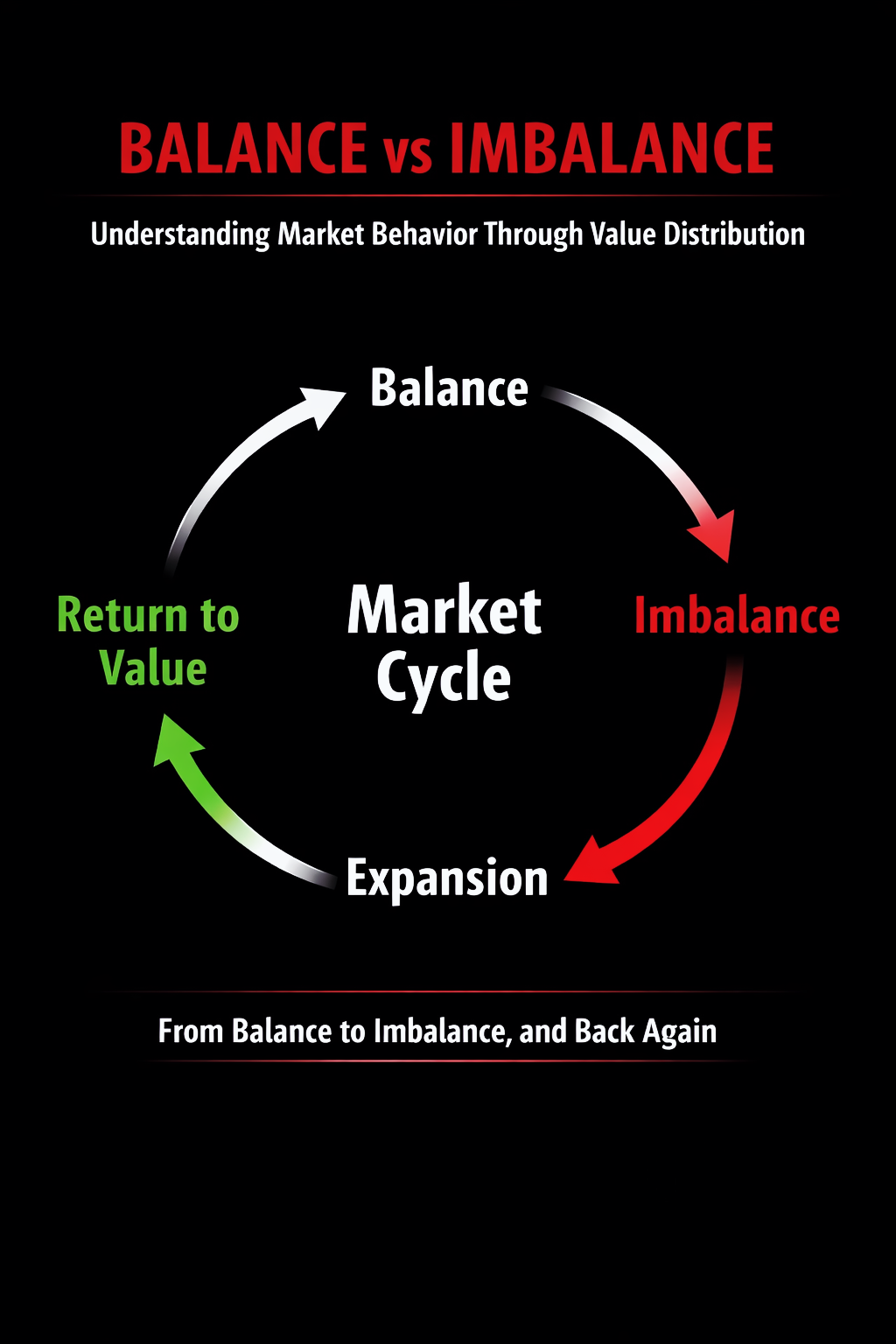
Markets tend to rotate between balance and imbalance. Balance creates sideways, mean-reverting behavior. Imbalance creates expansion as price searches for a new area of value.
Balance favors rotation and mean reversion.
Imbalance favors expansion and discovery.
Markets often return to value after expansion.
06Trader IntentResponsive vs Initiative Behavior
Responsive traders defend value, while initiative traders drive expansion away from value.
06
Trader Intent
Responsive vs Initiative Behavior
Responsive traders defend value, while initiative traders drive expansion away from value.
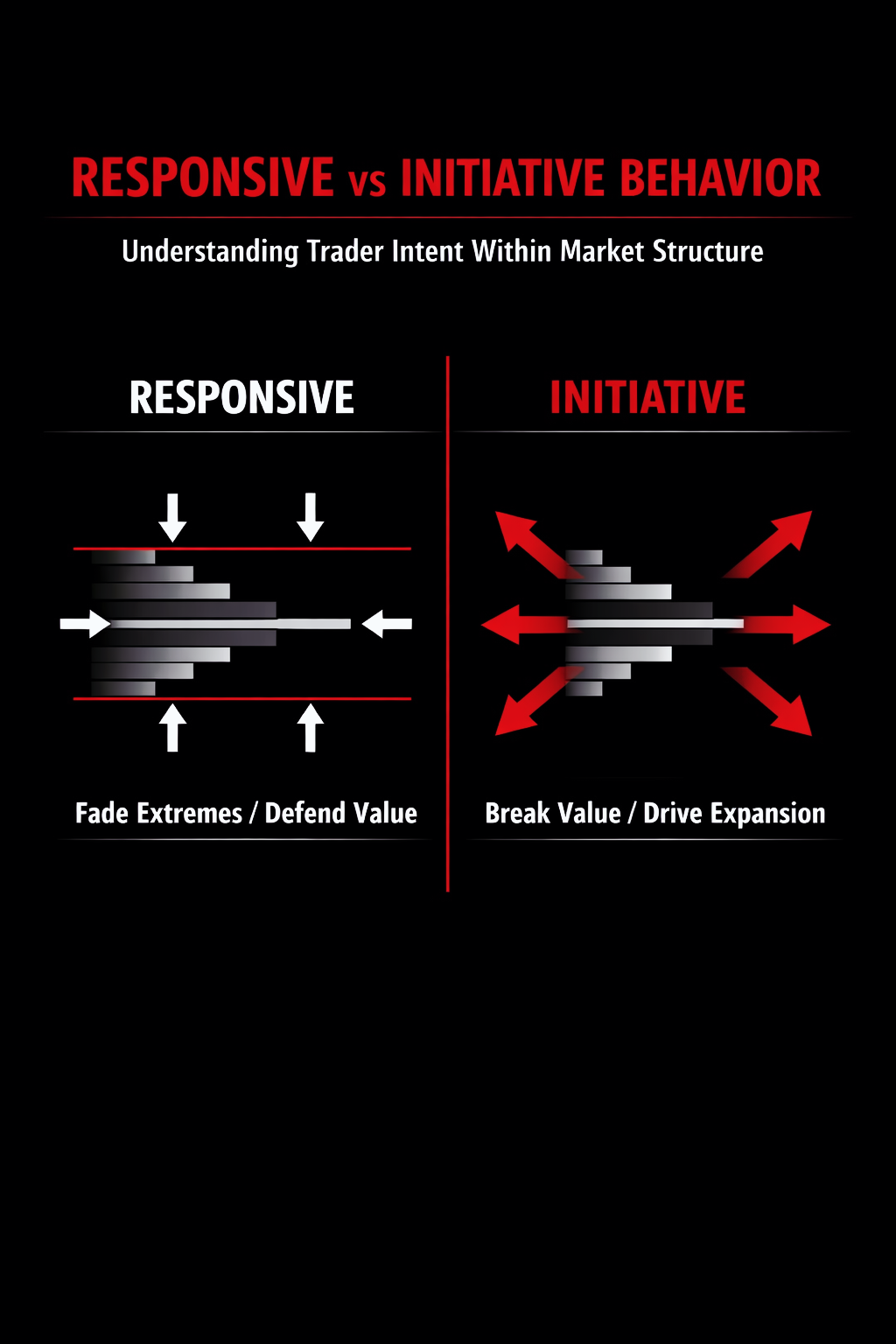
Responsive traders fade extremes and defend known value. Initiative traders push price away from accepted value to discover something new. Knowing which behavior is active helps traders avoid fighting the auction.
Responsive behavior defends value.
Initiative behavior drives expansion.
Intent changes how setups should be interpreted.
07Execution LogicFormulate Trade Possibilities
AMT helps separate mean reversion trade logic from price discovery trade logic.
07
Execution Logic
Formulate Trade Possibilities
AMT helps separate mean reversion trade logic from price discovery trade logic.
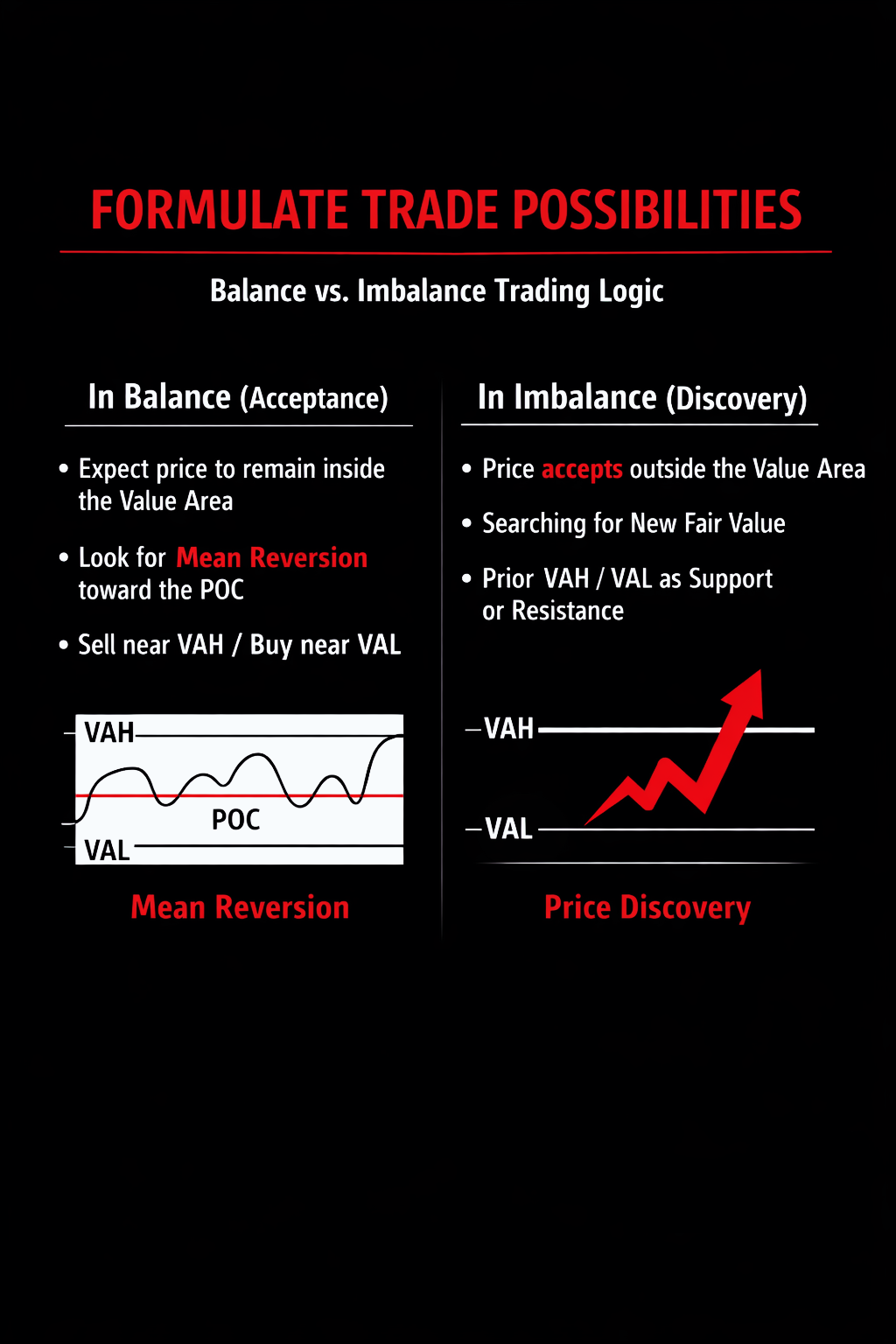
AMT helps traders decide whether the market is more likely to rotate back toward value or continue discovering new value. This is where market structure turns into practical trade planning.
Balance favors mean reversion toward POC.
Imbalance favors continuation and discovery.
Prior value levels can become support or resistance.
08ProcessHow to Use Auction Market Theory
Identify condition, define value, observe transitions, then plan the trade.
08
Process
How to Use Auction Market Theory
Identify condition, define value, observe transitions, then plan the trade.
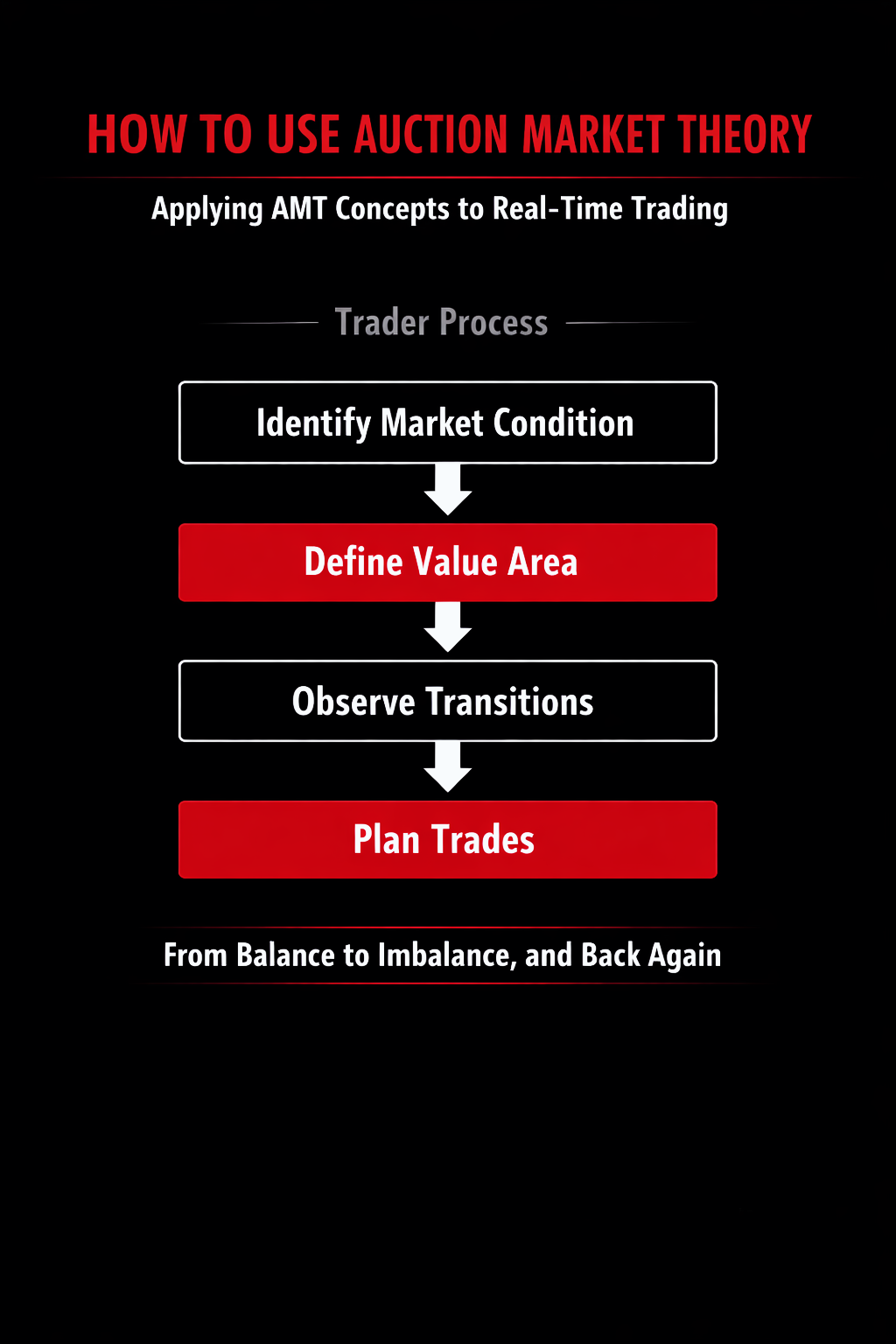
The process is simple but powerful: identify the market condition, define the value area, observe transitions, and then plan trades around what the auction is showing instead of reacting emotionally.
Identify market condition.
Define the value area.
Observe transitions before planning trades.
09SummaryCore Principles of AMT
AMT connects balance, imbalance, volume profile, value discovery, and trader behavior.
09
Summary
Core Principles of AMT
AMT connects balance, imbalance, volume profile, value discovery, and trader behavior.
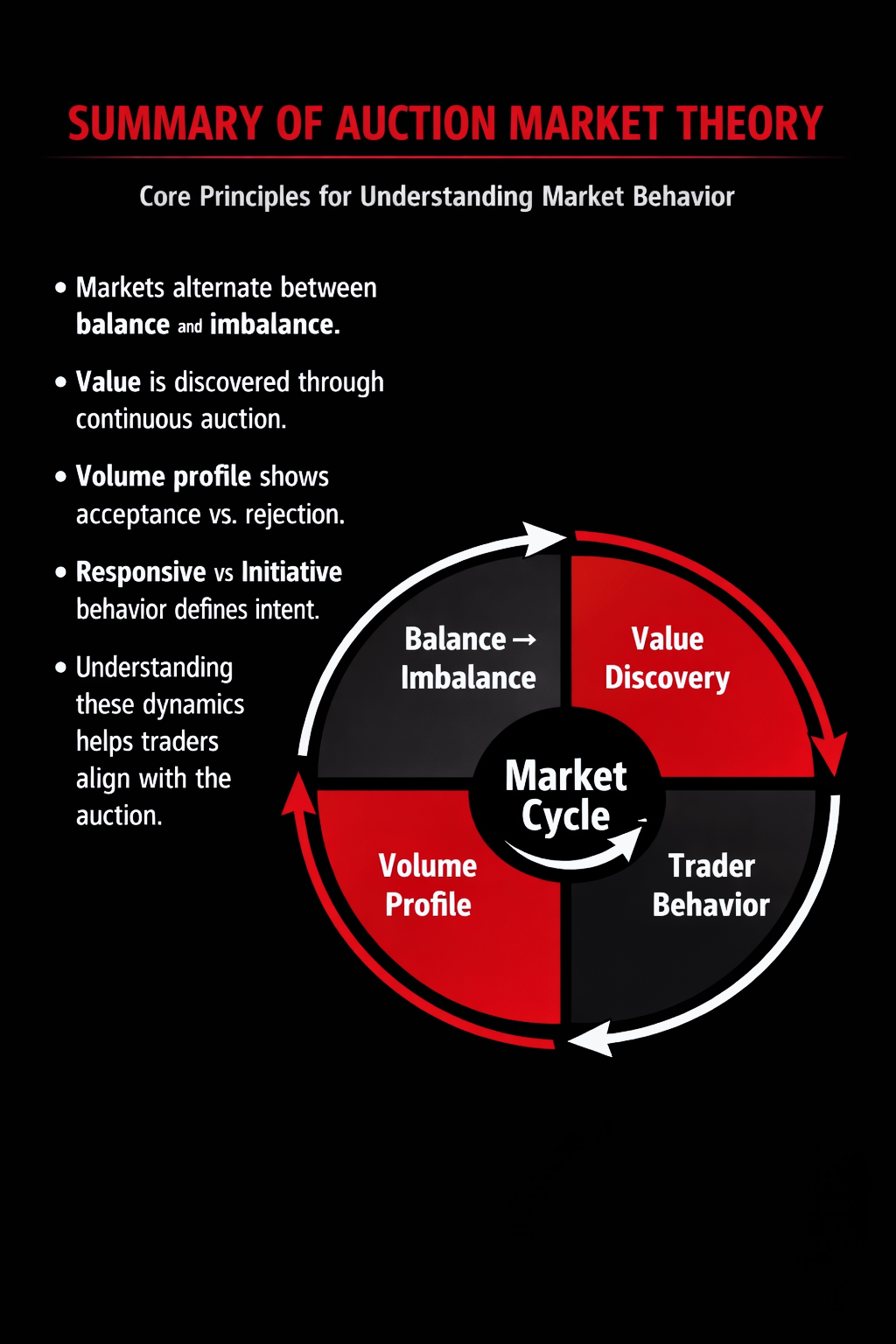
Auction Market Theory gives traders a framework for reading market behavior. It connects balance, imbalance, value discovery, volume profile, and trader intent into one practical structure.
Markets alternate between balance and imbalance.
Value is discovered through continuous auction.
Trader behavior reveals intent.
The Auction Never Stops
The goal is not to predict every move. The goal is to understand whether the market is accepting value, rejecting value, rotating inside balance, or expanding through imbalance.