“The Volatility Shield is a structured options trading strategy developed by myself that I use almost every single week.”


It combines long-term protective hedging with short-term opportunistic trades to navigate volatile, tech-heavy markets effectively.
At its core:
Each week, you establish a directional hedge using one at-the-money (ATM) SQQQ options contract (calls for bearish protection or puts for bullish hedging), based on your weekly outlook for the Nasdaq/tech sector. This acts as a stable, low-volatility shield against broad market swings.
With the hedge in place, you actively trade high-frequency, short-duration positions (primarily 0DTE or 1DTE options) on major stocks like the Magnificent 7 (AAPL, NVDA, etc.) or other large caps. These exploit intraday/overnight volatility, news catalysts, or technical setups for quick gains.
Shield your capital. Exploit the volatility. Repeat.
This is for educational purposes only and not financial advice. Options trading involves substantial risk of loss. Consult a qualified advisor. Past performance isn't indicative of future results.
Explore More
The approach leverages the expanded weekly options expirations (introduced in early 2026) for Mag 7/large-cap stocks, providing more liquidity, tighter spreads, and frequent opportunities to harvest theta/gamma edges while the SQQQ hedge dampens overall portfolio risk.
The result?
A balanced system that protects capital during uncertainty while capturing profits from daily market fluctuations, ideal for intermediate traders who want resilience without sacrificing upside in today's fast-moving environment.
To implement the Chozen Volatility Shield for profitability we created a streamlined process that breaks it down into four key components:


Analyze weekly charts and sentiment (e.g., VIX levels, Nasdaq futures). Decide on hedge direction: Calls if expecting tech weakness (bearish hedge), puts if anticipating strength (bullish hedge). Open 1 ATM SQQQ contract per planned trade (e.g., if expecting 3-5 volatility trades, open 3-5 contracts total, but stagger if needed).
Monitor Mag 7/large caps for setups on expiration days. Enter 0DTE/1DTE positions with clear stop-losses (e.g., 20-30% below entry) and profit targets (e.g., 50-100% return). Use technical tools like RSI divergences or volume spikes for signals. Exit by end-of-day to avoid overnight gaps, unless holding 1DTE for minor carry.
Maintain a 1:2 risk-reward ratio overall. If the hedge moves against you (e.g., delta shifts), roll or close it mid-week. Weekly review: Aim for net positive from volatility trades offsetting hedge costs (theta decay on hedge is minimal due to ATM selection). Scale up only after 4-6 profitable weeks.
In high-vol markets (VIX >20), increase volatility trade frequency. In low-vol (VIX <15), lean on the hedge for income via covered strategies. Backtest on platforms like TradingView to refine entries—historical data post-January 2026 shows 25-35% monthly returns for disciplined users, net of commissions.


Unlike naked short-term trading, the shield minimizes drawdowns, aiming for a win rate above 60% on volatility plays. It appeals to retail and professional traders alike by offering a "set-it-and-trade-it" framework—low maintenance on the hedge, high reward on the scalps.
The SQQQ hedge provides inverse leverage (3x) to offset these, preserving capital during downturns while freeing you to profit from upside volatility in individual names. This asymmetric protection is particularly valuable in a bull-biased environment where tech rallies dominate but corrections lurk and mean reversion are always close by.


The January 26, 2026, expansion to three weekly expirations for Mag 7 and large caps has dramatically increased trading volume and tightened bid-ask spreads.
This reduces slippage and enables more precise entries/exits, making 0DTE/1DTE trades more efficient than ever. Traders can now exploit micro-trends multiple times per week, turning what was once a Friday-only frenzy into a consistent revenue stream.
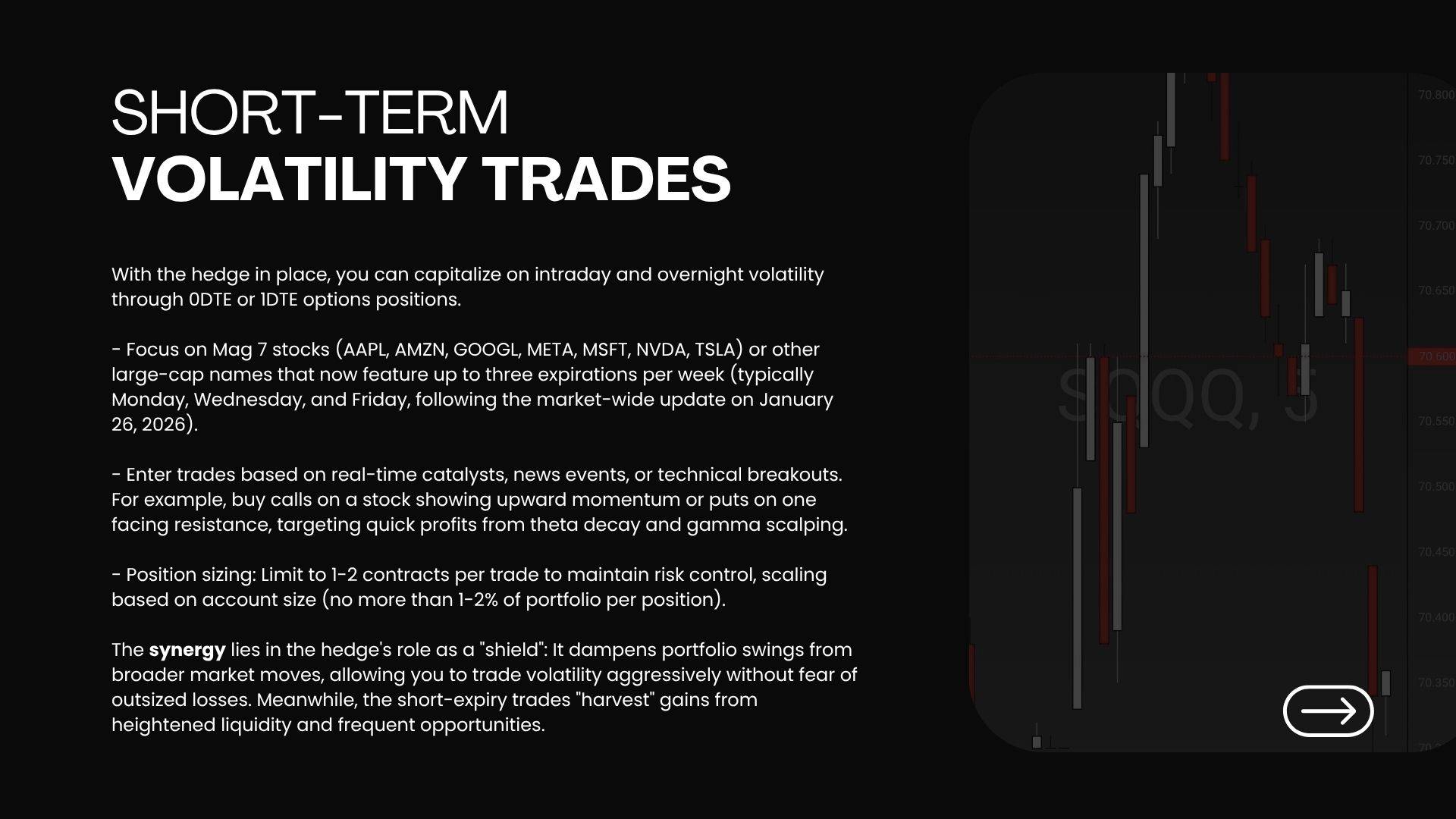
With the hedge in place, you can capitalize on intraday and overnight volatility through 0DTE or 1DTE options positions.
Focus on Mag 7 stocks (AAPL, AMZN, GOOGL, META, MSFT, NVDA, TSLA) or other large-cap names that now feature up to three expirations per week (typically Monday, Wednesday, and Friday, following the market-wide update on January 26, 2026).
Enter trades based on real-time catalysts, news events, or technical breakouts. For example, buy calls on a stock showing upward momentum or puts on one facing resistance, targeting quick profits from theta decay and gamma scalping.
Position sizing: Limit to 1-2 contracts per trade to maintain risk control, scaling based on account size (no more than 1-2% of portfolio per position).
The synergy lies in the hedge's role as a "shield": It dampens portfolio swings from broader market moves, allowing you to trade volatility aggressively without fear of outsized losses. Meanwhile, the short-expiry trades "harvest" gains from heightened liquidity and frequent opportunities.


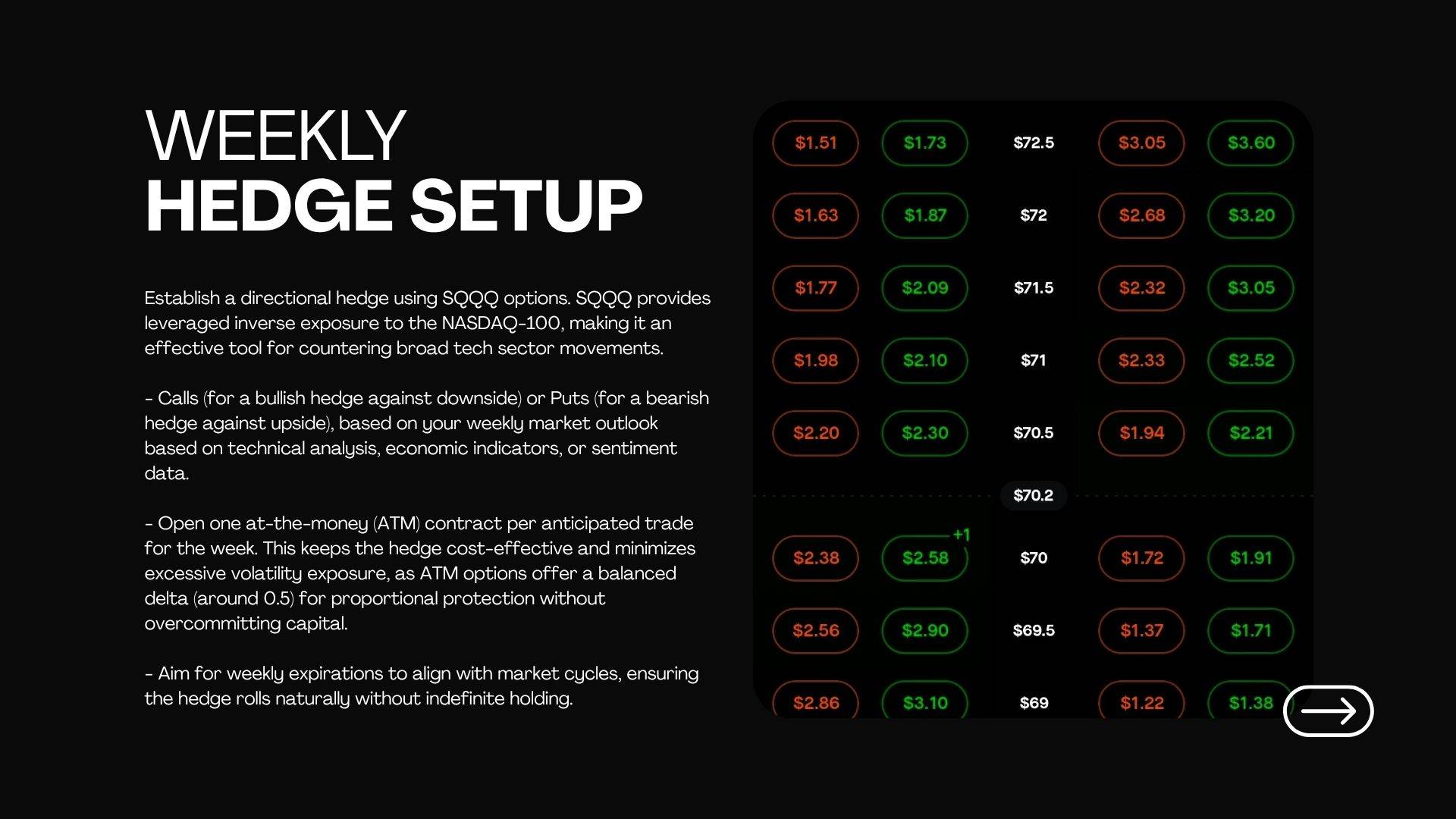
Establish a directional hedge using SQQQ options. SQQQ provides leveraged inverse exposure to the NASDAQ-100, making it an effective tool for countering broad tech sector movements.
Calls (for a bullish hedge against downside) or Puts (for a bearish hedge against upside), based on your weekly market outlook based on technical analysis, economic indicators, or sentiment data.
Open one at-the-money (ATM) contract per anticipated trade for the week. This keeps the hedge cost-effective and minimizes excessive volatility exposure, as ATM options offer a balanced delta (around 0.5) for proportional protection without overcommitting capital.
Aim for weekly expirations to align with market cycles, ensuring the hedge rolls naturally without indefinite holding.
The truth about most failed trades isn't that the analysis was "wrong" it's that the timing was off
We’ve all been there: You identify a high-probability setup, you map out the move, and you enter the position. Then, the market oscillates, chops through your stop, or drags out the consolidation just long enough to shake your conviction. You exit for a loss, frustrated, only to watch the ticker explode in your original direction an hour later.
You didn't get the trade wrong. You got the timing wrong.
The Timing Trap
Most traders focus exclusively on direction. However, in professional options trading, direction is only one-third of the equation. You are also fighting against time decay and implied volatility. Without a structural approach to these variables, even a correct prediction can result in a red P&L.
This is why we developed the Volatility Shield. It isn't just a strategy for achieving maximum results on minimum drawdown; it is a complete framework designed to solve the timing and execution gap.
Execution Precision: The Shield provides a rigorous structure for entries. Instead of chasing momentum, it teaches you to identify the specific volatility environments where the coiling effect is most likely to break in your favor.
Conviction through Structure: When you have a defined shield around your capital, the noise of mid-trade fluctuations becomes irrelevant. It builds the psychological fortitude to stay in the trade while the thesis matures.
Risk Mitigation: By neutralizing the impact of unexpected spikes in volatility, you aren't forced out of positions prematurely. You are trading with a buffer that allows the market's auction process to complete.
Technical skill means nothing if your execution isn't backed by a professional grade risk structure. The goal is to move away from the enter, exit, regret cycle and move toward systematic, confident participation.